
From Data to Decisions: How CarbonTrack Strengthened Crawley’s Climate Emergency Action Plan
See how Crawley Borough Council partnered with CarbonTrack to strengthen its Climate Emergency Action Plan with a comprehensive, data-driven emissions baseline. CarbonTrack’s analysis revealed that while direct emissions (Scopes 1 and 2) were relatively limited and actionable, supply chain and estate-related emissions (Scope 3) were far larger and more complex to address. By embedding these insights into procurement and estate strategy, and aligning targets with best practice, Crawley is now equipped with a clearer, evidence-based pathway to net zero.
Setting the Scene: Crawley’s Climate Emergency and Net Zero Ambition
Crawley Borough Council declared a climate emergency in 2019, committing to a 50% reduction in emissions by 2030 and achieving net zero by 2040 “at the very latest.” To deliver against this ambition, the Council recognised the importance of robust evidence: specifically, a clear understanding of the full extent of its emissions, including those outside its direct operational control.
The Challenge: Why Traditional Carbon Accounting Fell Short
CarbonTrack was commissioned to refresh and enhance the Council’s approach to net zero greenhouse gas (GHG) emissions. Central to this work was the establishment of a complete, data-driven baseline covering Scopes 1, 2, and 3. While Scopes 1 and 2 (direct energy use and operations) could be quantified with relative certainty, Scope 3 presented a greater challenge. These indirect emissions – particularly those from procurement, capital expenditure, and leased assets – represent the majority of most local authorities’ carbon footprints, yet are rarely comprehensively measured.
The CarbonTrack Solution: Forensic Analysis and a High-Resolution Emissions Profile
Through a forensic, insight-led analysis of emissions sources, CarbonTrack produced a high-resolution emissions profile that allowed the Council to see its footprint in unprecedented detail.
Key Insight: Uncovering Crawley’s Dominant Scope 3 Emissions
The analysis highlighted two critical findings:
Direct emissions (Scopes 1 and 2) were both smaller in scale and more straightforward to address, with tangible opportunities for accelerated progress. For example, CarbonTrack’s assessment of energy consumption across the Council’s offices identified specific efficiency interventions and electrification pathways for buildings and fleet that could deliver near-term reductions.
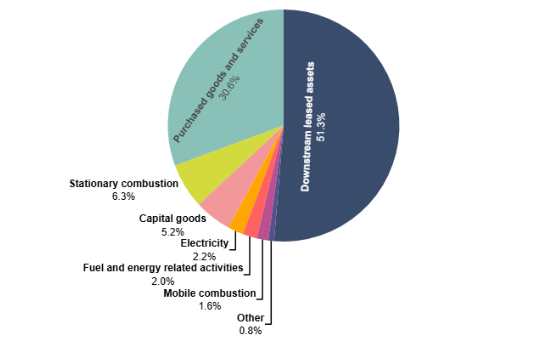
Indirect emissions (Scope 3) constituted a much larger share of the footprint, particularly in categories such as purchased goods and services, capital projects, and downstream leased assets (e.g. leisure centres and social housing). These emissions are heavily shaped by external actors, including suppliers and landlords, meaning that reductions require longer-term engagement strategies, incremental expectations, and supportive policy frameworks.
Nearly 90% of Crawley’s total footprint comes from Scope 3 emissions in its supply chain and leased estate.
From Data to Decisions: Recalibrating the Climate Emergency Action Plan (CEAP)
Beyond measurement, CarbonTrack reviewed the Council’s Climate Emergency Action Plan (CEAP), providing expert consultancy to align strategy with the evidence base. Recommendations covered priority-setting, sequencing of actions, integration of procurement criteria, and the development of a more differentiated target structure.
The Result: Implementing a Differentiated Net Zero Pathway and Updated Targets
The outcome was a recalibrated pathway to net zero, grounded in empirical analysis and aligned with best practice. Crawley Borough Council adopted updated targets: accelerating the timeline for direct (Scopes 1 and 2) emissions to 2030, while setting a longer-term 2045 target for indirect (Scope 3) emissions. This differentiated approach reflects both ambition and realism — demonstrating leadership where the Council has immediate control, while building a credible, evidence-led trajectory for harder-to-treat emissions sources.